One Car, One Cargo Bike? The Real-World Arithmetic of Dropping a Runabout in Harrogate
The second car is often the most expensive thing in a Harrogate driveway that nobody wants to think about. It sits there for the school run, the Saturday shop, the trip to the station and the odd evening errand. Replacing it with an e-cargo bike sounds tidy on paper. In practice, it is a household logistics question dressed up as a bike question.
This is not a pitch for selling the estate car tomorrow. It is a way of working out whether a cargo e-bike could cover enough of your short journeys to make one car do the job of two. Around Harrogate, that answer changes street by street.
Start with the journeys, not the bike
Most second cars do not spend their lives on the A1. They do the same small loops: Bilton to a school gate, Starbeck to the shops, Knaresborough to the station, or a run into Harrogate town centre for a haircut and a bag of shopping. Those trips are often two to five miles each way. They are also the trips an e-cargo bike handles best.
A cargo bike is not a slower car. It is a different tool. It carries less, goes slower and gets wetter. But it also parks at the school gate, slips past queueing traffic on Wetherby Road and costs pennies to plug in. The useful question is not whether it can do everything. It is whether it can do the 60 or 70 per cent of second-car trips that are short, local and predictable.
The Harrogate terrain test
Harrogate is not the Alps, but it is not flat either. A loaded cargo bike climbing from town up towards Bilton or hauling shopping up a Knaresborough hill is a different proposition from an unladen commuter e-bike. Crank-drive motors with sensible gearing generally cope better with cargo and hills than a basic hub motor, but the real test is a test ride with weight on board.
Starbeck and the flatter routes towards the Showground are easier. The town centre is manageable if you choose your route rather than following the most direct road. Wet leaves and grit in November are the bigger issue: a cargo bike is long, heavy and not especially nimble on a greasy cycle path. Good tyres, working lights and a modest speed matter more than a big battery figure.
What a cargo bike actually swallows
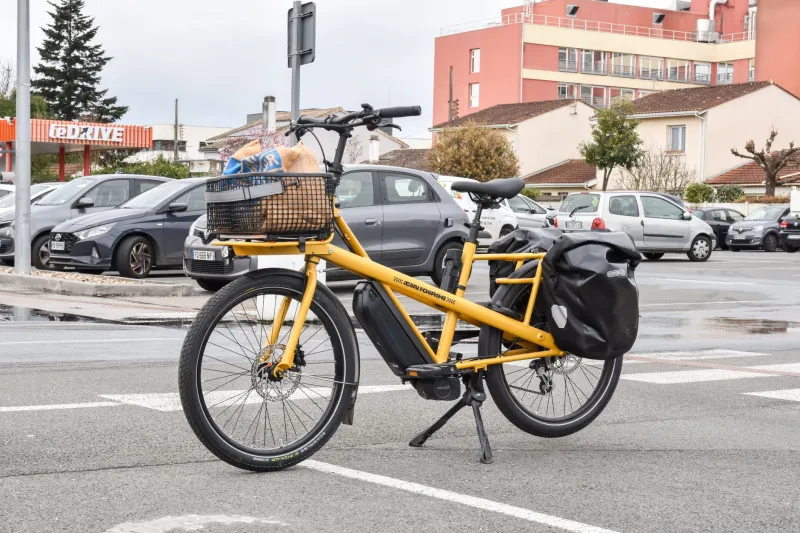
A decent family cargo bike can take two children, or a week of supermarket shopping, or a mix of bags, coats and scooters. Box bikes and longtails do different jobs. A box bike is brilliant for school runs and bulky loads. A longtail feels more like a normal bike and can be easier to store, but it is less generous with younger children and wet-weather covers.
Think about the awkward loads. A bag of compost from a garden centre. A birthday present. A child who has fallen asleep. A cargo bike can do more than most people expect, but it will not replace a car for a tip run, a flat-pack wardrobe or a wet Tuesday when everyone is late.
Storage is the make-or-break
This is where many Harrogate households discover the truth. A cargo bike is long. It needs ground-level access, somewhere secure and enough turning space to get in and out without reversing into the recycling boxes. A terraced house with a narrow hallway is a poor match. A Bilton driveway, a Starbeck yard or a garage with a wide door is a much better one.
If the bike lives outside, it needs a proper anchor, a decent lock and insurance that covers theft away from home. If it lives in a shed, check the door width before you buy. Charging is usually simple: a normal socket and a battery you can remove. But a cargo bike battery is heavy, so siting the charge point near the bike is kinder than carrying it upstairs every night.
Rain, dark and the school gate
Harrogate weather is not a reason to avoid a cargo bike, but it is a reason to buy the right kit. A rain cover for the box, waterproof trousers for the rider, gloves that actually work in the wet and a good front light are not accessories. They are part of the vehicle. Without them, the bike stays in the shed and the car gets used anyway.
The school gate is the other reality check. A cargo bike can be easier than a car because you are not circling for a space. It can also be harder because you are managing children, bags and a large bike in a crowd. A dry run at the actual school drop-off time tells you more than any specification sheet.
The 2026 money conversation
A new family e-cargo bike in 2026 is not cheap. Expect roughly £2,500 to £6,000 depending on the brand, motor, box and extras. Accessories, insurance and a proper lock can add several hundred pounds. That is a lot of money for something that does not have a heated rear window.
Against that, run the second car properly. Insurance, vehicle tax, MOT, servicing, tyres, fuel, parking charges and depreciation all count. If you genuinely sell the car, the savings can be substantial. If you keep the car and add a cargo bike, the maths is much weaker. The bike has to replace journeys, not sit beside the thing it was meant to replace.
Running costs are modest. Electricity for short local trips is pennies rather than pounds. Servicing is simpler than a car, though brakes and tyres wear faster on a loaded bike. A battery replacement in a few years will be a real cost, not a myth. Cycle-to-work schemes can help if your employer offers one, but they are not a universal discount.
The days it will not work
A cargo bike will not cover every second-car duty. Long family trips, holidays, visiting relatives in the Dales, a child too ill to ride, or a day of horizontal rain all point back to a car, a taxi, the bus or the train. That does not make the idea silly. It just means fewer wheels only works if the household has a plan for the exceptions.
For some Harrogate families, the answer is one car plus a cargo bike plus occasional car hire. For others, it is two cars and a normal e-bike for local errands. Both can be sensible. The mistake is assuming a cargo bike is a direct one-for-one swap without changing how the week is organised.
A sensible trial before selling
Before you sell anything, borrow or demo a cargo bike for a month. Use it for the school run, the supermarket trip and the station dash. Test it loaded, in the rain, at the times you actually travel. Check storage, insurance and charging. Then look at your diary and count how many second-car journeys it genuinely handled.
If most of your short local trips disappear from the car, an e-cargo bike can be a practical replacement around Harrogate. If they do not, it can still be a brilliant addition. The honest arithmetic is not about whether a cargo bike is good. It is about whether your household can live with fewer wheels on the days when the weather, the hills and the school gate all test the idea at once.