From Bilton to the School Gate: What a Battery Really Changes on a Harrogate School Run
The fantasy is easy to picture. You glide past the queue on Wetherby Road, child waving from a smart rear seat, battery quietly flattening the climb home. The reality involves a damp jacket, a school gate that was never designed for bikes, and a discussion about whether the bike can live in the corridor. None of that makes an e-bike a bad idea for the Harrogate school run. It just means the decision needs a bit less brochure and a bit more Bilton-to-Beckwithshaw honesty.
First, the bit nobody photographs: the school gate
Most Harrogate schools were not built around cargo bikes. At drop-off time, entrances get crowded, pavements fill up, and the car park becomes a slow-motion argument. A bike can skip a lot of that, but only if you plan where you will actually stop. Do not assume you can wheel up to the gate, lean the bike against the wall and be gone. Check the school's policy before term starts. Some sites have cycle shelters; others have a single rack near reception and a caretaker who would rather you did not add to the scrum.
Timing matters as much as route. Leaving ten minutes earlier often beats buying a faster bike. A loaded e-bike is still a bike: it needs space, it does not belong on the pavement, and it will not magically clear a narrow entrance. If your child's school is on a busy road, find the quiet approach street and walk the last hundred metres. That is not a failure of the e-bike dream. It is how the school run works.
Child seat, longtail or cargo? Start with the child
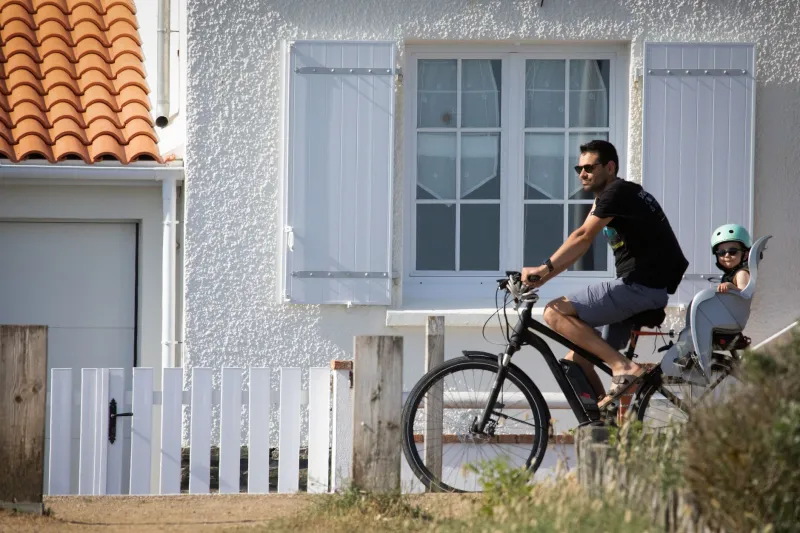
For one child, a properly fitted rear child seat is usually the simplest and cheapest route. Look at the seat's weight limit and the bike's rack limit — they are not always the same. A seat mounted over the rear wheel raises the centre of gravity, so a loaded bike can feel top-heavy at walking pace. Practise with a bag of rice before you add a wriggling passenger.
For two children, the conversation changes. A longtail or cargo bike gives you a lower, more stable platform, but it is a big object to store, lock and manoeuvre around Harrogate's narrower back streets. A trailer is another option for some families, but it makes the school gate more complicated and needs a careful look at the route. Do not buy the biggest bike first. Borrow or demo a child seat setup, then decide whether you genuinely need cargo capacity.
The Harrogate hill test
Bilton to Beckwithshaw, Harlow Hill, Cold Bath Road, the drag up from Oatlands — these are the places where an e-bike earns its keep. But a motor does not remove the need for gears. On a loaded school bike, you want to be in a low gear before the hill starts, not halfway up with a child asking why you have stopped.
Torque figures matter less than how the bike delivers power at low speed. A crank-drive bike that pulls smoothly from walking pace is usually easier with a child seat than a hub motor that feels punchy only once you are moving. Cold weather and extra weight both eat into range, so do not size your battery around a solo summer commute. If your round trip is six miles with a child and a headwind, give yourself real margin. And check the brakes with the child aboard, on a quiet street, before you trust them on a wet descent.
The wet-weather kit that actually gets used
Harrogate weather does not require a cycling wardrobe. It requires a few things that work. Full mudguards are not cosmetic; they keep spray off your child's legs and your own back. Disc brakes are worth having on wet, gritty lanes. A waterproof cover for the child seat gets used far more than a fancy rain jacket for you.
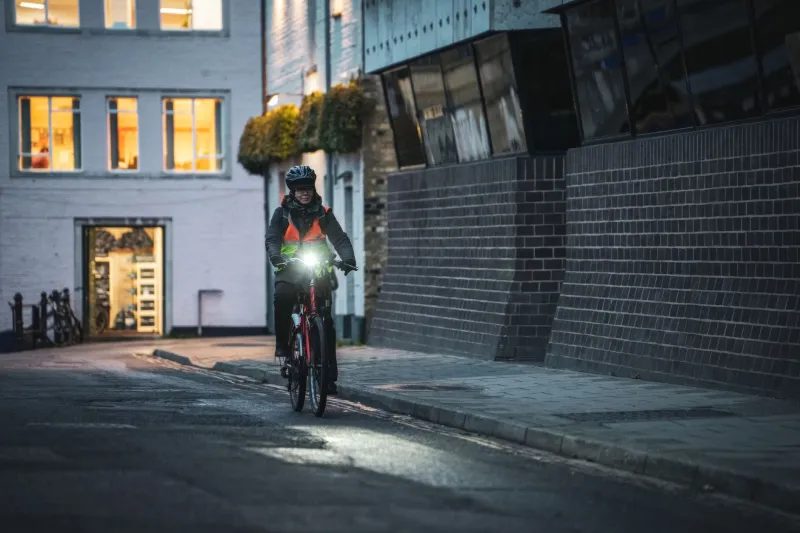
Keep a small dry bag with spare gloves and a thin waterproof layer for your child at school if the school allows it. Lights should be on in daylight rain, not just at dusk. Reflective ankle bands and a bright cover for the seat are cheap and visible. The goal is not to look like a cycling instructor. It is to arrive with everyone's mood intact.
School storage: ask before you buy
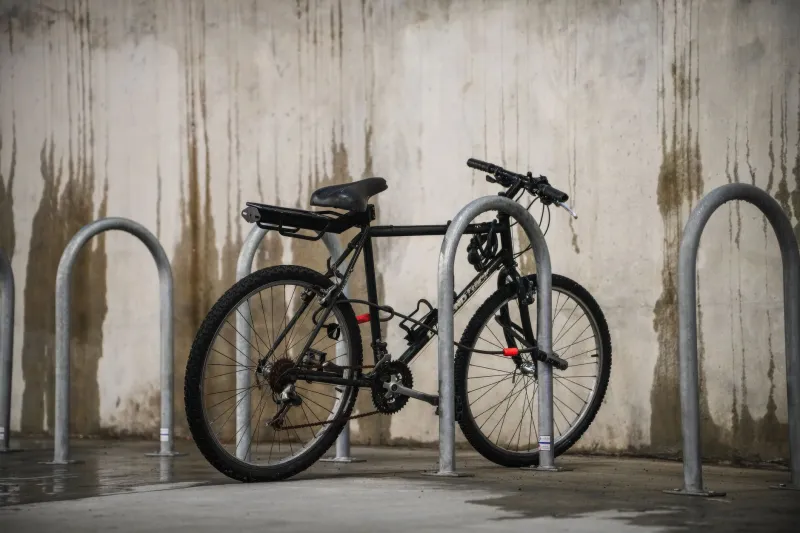
This is the question that sinks more school-run e-bike plans than hills ever do. Where does the bike live during the school day? If you are riding home again straight away, fine. If you are commuting onward, you need a plan. Some parents lock up at a nearby leisure centre or use a secure cycle hangar. Others find that the school has no suitable rack and the bike becomes a liability.
Ask the school office directly. Do not assume a rack is fair game because it exists. If you are locking to railings, make sure you are not blocking a fire exit, a ramp or a pedestrian route. Use a good lock, and take the battery with you if the bike is staying somewhere exposed. An e-bike is heavy enough that lifting it onto a high rack may not be realistic with a child in tow, so test that manoeuvre before term begins.
The legal bits parents ask about
A legal e-bike in the UK is an electrically assisted pedal cycle: 250 watts, assistance cutting out at 15.5mph, and power only when you are pedalling. If it has a throttle and can go without pedalling, it is not a standard EAPC, and that changes the rules. You do not need a licence or insurance for a legal e-bike, but check your home insurance if the bike is expensive and stored away from home.
Child seats should be designed for the job and fitted to the manufacturer's instructions. Helmets are not compulsory in the UK, but they are sensible for children. Pavements are not for cycling unless signs permit it, and the same speed limits and traffic laws apply. If you are considering a trailer, check the route and the bike manufacturer's guidance. The legal side is not there to spoil the fun; it is there so the school run stays boring in the right way.
The honest verdict
An e-bike can replace a surprising number of short car trips around Harrogate. For families within a few miles of school, with one or two children and somewhere safe to leave the bike, it can be genuinely brilliant. It will not fix a chaotic school gate, a child who refuses a helmet, or a school with nowhere to park a cargo bike. Start with a trial run on a quiet day, not the first Monday of term. If the route, the storage and the child all work, the battery is a bonus. If they do not, no motor is strong enough to carry that much wishful thinking.