Rack, Strain and Rethink: Getting a Heavy E-Bike Out of Harrogate Without a Bad Back
An e-bike is a lovely thing on the road and a lump in the car park. That is the awkward truth behind a lot of otherwise sensible plans. You fancy a ride out towards Ripley or a loop beyond Knaresborough, then you remember the bike weighs somewhere between a small child and a bag of sand, and the car rack is still in the garage under a tarpaulin. In 2026, the racks themselves are better than ever, but the basic physics has not changed: a heavy bike has to be lifted, clamped and trusted at 60mph.
First, weigh the actual thing
Most rack problems start with a number nobody checked. Brochure weights are often for a bare bike, without pedals, mudguards, a lock bracket or a full battery. Pop the bike on bathroom scales, or weigh yourself holding it, and write the figure down. Then read the rack’s maximum per-bike weight, its total weight limit and the car’s own limits. For a roof rack, that means the roof load figure in the handbook. For a towbar rack, it means the towbar’s vertical load or nose weight, which includes the rack itself as well as the bikes.
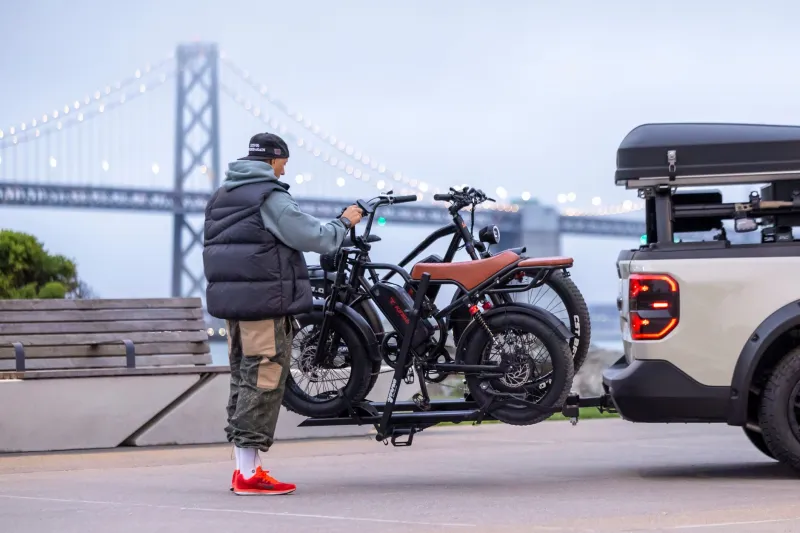
This is where two e-bikes can get quietly silly. A pair of 25kg bikes plus a 15kg platform rack is 65kg hanging off the back. Plenty of towbars will not thank you for that, and some cars run out of nose weight long before the rack runs out of spaces. Removing a removable battery can help, but check the manufacturer’s guidance first; some racks and bikes are fine with it, others are not, and you do not want to find out by watching a battery bounce down the A61.
Towbar racks: usually the least bad option
For heavy e-bikes, a towbar-mounted platform rack is often the sensible default. The bikes sit lower, you are not lifting them above your head, and many models offer a ramp or a tilt function so you can get into the boot without unloading everything. The catch is that you need a towbar, the electrics need to work, and the nose weight maths has to add up. A lighting board and number plate are not optional extras if the rack obscures the car’s own lights.
Roof racks are fine for light road bikes and deeply unappealing for a 25kg e-bike. Lifting that weight to roof height, often while leaning over a car wing, is a recipe for a tweaked back and a scratched roof. Add low barriers, car park height limits and the simple fact that you have to do it all again at the other end, and the romance fades. If you already have roof bars, check the load limit and think hard about whether you really want to press your luck.
Boot-mounted racks are the other common temptation. Many are simply not rated for e-bikes, and the ones that are tend to have strict per-bike and total limits. Straps can rub paint, hatchback struts can object, and the whole arrangement can feel less reassuring when the bike weighs more than the rack was designed for. It can work for one lighter e-bike on a short local trip, but read the small print rather than assuming that because it held a hybrid in 2019 it will hold an e-bike now.
Lifting without regret
The best lifting technique is the one you do not need. A ramp, a step stool and a second pair of hands are not signs of weakness; they are signs of experience. Where possible, remove the battery and any obvious heavy extras before lifting. Keep the bike close to your body, bend at the knees, and avoid twisting while it is in the air. Never lift by a mudguard, rear rack or brake hose, and clear a path before you start rather than shuffling sideways with a motor in your arms.
If you are loading alone, practise when you are not in a hurry. A dry run in the driveway on a mild Saturday is much better than a windy Sunday evening with a ferry to catch. Check that the clamps grip the frame, not a cable or a thin mudguard stay, and give the bike a gentle shake once it is on. If it moves more than you would like, stop and rethink rather than hoping motorway speed will settle it.
The doorstep question
Here is the thing about Harrogate: a lot of the rides people load a car for are perfectly reachable from the front door. The Nidderdale Greenway towards Ripley is a obvious one. Knaresborough, Starbeck, the Crimple Valley lanes and plenty of steady loops around Bilton and beyond can all start at home. If the car journey is shorter than the ride, the rack is often more hassle than it is worth.
Use the car when it genuinely opens up a day out, not as a default. If you are heading further into the Dales or meeting friends near Otley, a rack makes sense. If you are simply trying to avoid the first hill out of town, remember that the battery is there for exactly that. Riding from the doorstep also means no nose weight maths, no straps flapping and no late-night unloading in the rain.
Before any trip, do a five-minute load check: bike weight, rack limit, car limit, clamps tight, lights working, nothing loose. Then ask yourself whether the car is really doing you a favour. Sometimes it is. Sometimes the better answer is to leave it on the drive and ride away.