Five-Thirty Fade: Visibility That Actually Works on Harrogate Winter Commutes
Photo: James Ricalton, Public domain, via Wikimedia Commons
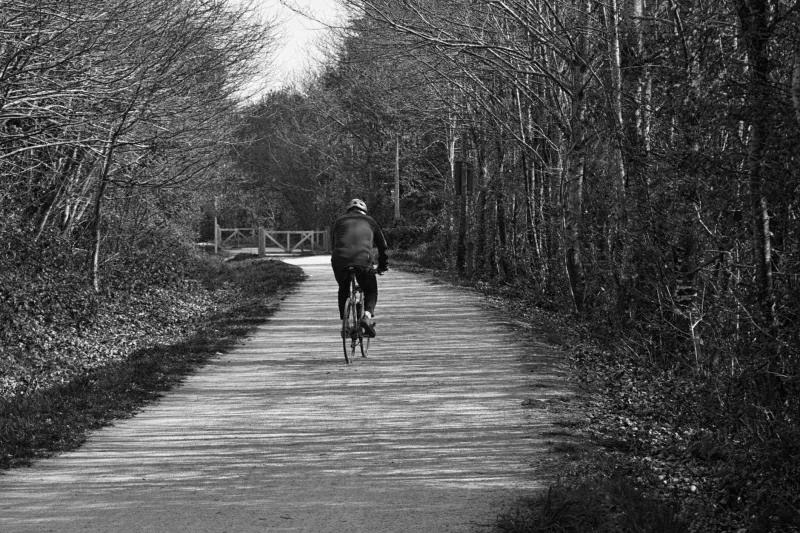
There is a moment in November when the Harrogate commute changes character. You leave work in town, the sky is already the colour of wet slate, and the run home to Bilton or Starbeck feels less like a bike ride and more like a low-speed negotiation with badly aimed headlights. By 5.30pm, the Otley Road cycle path is busy, the Nidderdale Greenway is properly dark, and the lanes out towards Beckwithshaw have that damp, reflective sheen that makes everything harder to read.
This is not a lecture about dressing like a Christmas tree. It is about being seen early enough, clearly enough and from the right angles — without spending a fortune or flattening your e-bike battery before Thursday.
The legal floor is lower than you think
UK bike lighting law gives you a baseline, not a complete safety strategy. At night you need a white front lamp and a red rear lamp, plus a red rear reflector. Pedal reflectors are part of the construction rules for many conventional bikes, so check what your e-bike was actually supplied with rather than assuming it is exempt. Flashing lights are permitted for bicycles if the lamp is approved for road use, but a steady beam is usually easier for drivers to judge on a wet road. A flash mode is fine as a back-up or attention-grabber; it is not a substitute for a proper beam pattern.
None of that tells you how much light you need on an unlit stretch of greenway, or whether your rear light is visible from a side road. That is the practical bit, and it is where most commuters underspend their attention rather than their money.
What lights really do to your e-bike battery
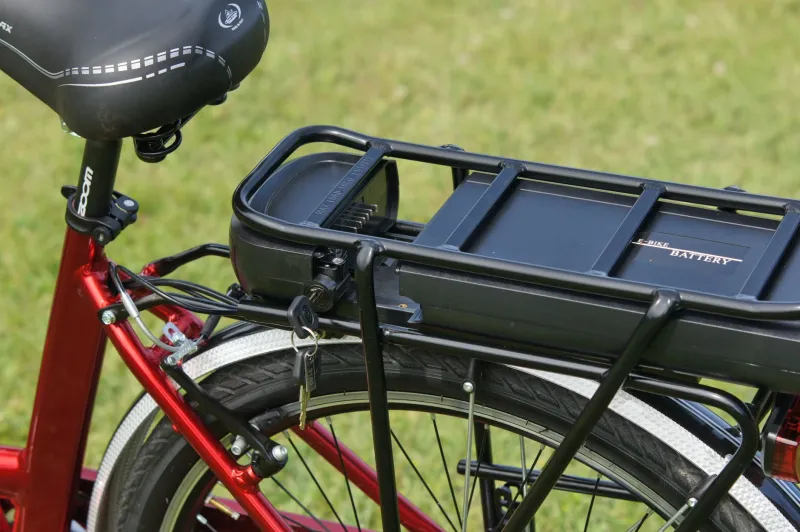
If your e-bike has factory-integrated lights running off the main battery, the drain is usually modest. A typical commuter lighting set-up might draw somewhere in the region of 5–15 watts. On a 500Wh battery, a couple of hours of commuting with lights on is likely to cost you a few per cent of range — less than a cold headwind, a hilly detour or a badly inflated rear tyre. The bigger issue is cold. Lithium batteries are less happy at 2°C than at 15°C, so a battery that is already low and chilly will sag more noticeably when you add lights, a phone charger and a motor working harder in the wet.
USB lights are a different bargain. They do not touch the e-bike battery, but they have their own small cells and they will run flat at the least convenient moment. Treat them like your phone: charge them indoors, not in a freezing shed, and keep a tiny emergency front and rear light in your bag. If you have wired lights, check the connectors and cable routing before the really grim weather arrives. A flickering rear light caused by a damp connection is worse than no light at all, because it looks like a faulty bike.
Reflective is not the same as fluorescent
High-visibility yellow is brilliant in daylight and surprisingly ordinary after dark. What works at night is retroreflection: material that throws light back towards the driver who is shining it. That means reflective ankle bands, reflective strips on gloves, a reflective patch on a backpack, or a jacket with proper retroreflective panels rather than just a bright colour.
Moving reflectives are especially useful. Ankles and pedals rise and fall, which helps a driver identify a cyclist rather than a static blob. Reflective sidewall tyres are another quiet winner on the Otley Road cycle path, where side roads and driveways create the classic ‘didn’t see you coming’ risk. Keep the lenses clean, too. A muddy rear light on a wet November evening is doing about as much good as a chocolate tea pot.
Where to sit in the lane
On unlit lanes — the roads out past Harlow Carr, or the quieter loops towards Beckwithshaw and Norwood — do not hug the verge. Hang back a little, take the lane through bends, and give drivers a chance to see you before they commit to an overtake. A bright light pointed straight at the tarmac two metres ahead is not much use to someone coming round a corner. Aim the front beam so it illuminates the road without blinding oncoming traffic, and use a lower setting on shared paths.
The Nidderdale Greenway is a good test of manners as well as kit. It is dark, popular with walkers and often damp under the trees. A broad, low beam is more useful than a narrow spotlight, and a helmet-mounted light should be dipped or switched off when someone is approaching. On the Otley Road cycle path, watch the junction mouths rather than staring at the white line. That is where a driver pulling out will look for a gap, not necessarily for you.
A sensible November set-up
You do not need to spend £200 to be conspicuously visible. A reliable front light in the 400–800 lumen range, a decent rear light with a wide spread, a red reflector, reflective ankle bands and a jacket or bag with retroreflective detailing will cover most Harrogate commuting. Add a small back-up rear light and keep a USB cable at work. If you ride the greenway regularly, consider a second front light with a wider beam for the unlit sections and run it lower to protect battery and courtesy.
Test the whole set-up at dusk, not in the dark. Put the bike on the drive, walk 20 metres away, and see what a driver or pedestrian would actually notice. Then check it from the side and from behind. The question is not ‘am I lit?’ but ‘am I understandable?’ — a cyclist, moving at a predictable speed, on a wet road, with a clear gap to pass.
By the time the five-thirty fade becomes the default, that small routine is worth more than another gadget. Harrogate’s winter commuting is not especially dangerous, but it is unforgiving of vague lighting and vague positioning. Be bright, be early, and be obvious.