The Two-Bike Rule: Getting an E-Bike Onto the Harrogate Line Without Guesswork
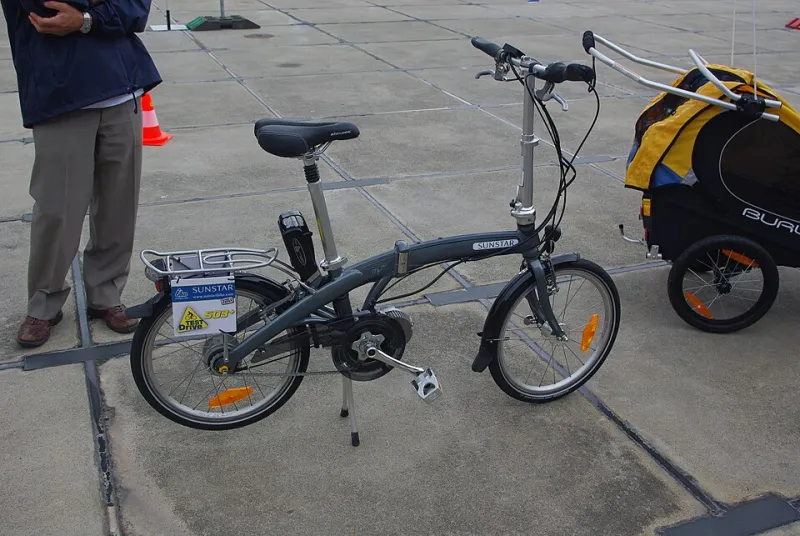
Photo: Clément Bucco-Lechat, CC BY-SA 3.0, via Wikimedia Commons
Combining an e-bike with the train sounds like the obvious answer to the Harrogate commute. Ride to the station, roll onto a service to Leeds or York, and skip the traffic and the weather. In practice, the railway has its own ideas about bicycles, and an e-bike adds a battery, extra weight and a few reasonable questions from staff. None of it is impossible. It just needs a bit less optimism and a bit more planning.
Why bother mixing rail and e-bike?
The appeal is obvious if you live in Bilton, Starbeck or Knaresborough and work in Leeds or York. An e-bike turns the station run into something you can do in ordinary clothes, without arriving at the platform needing a shower. It also widens the catchment: a station that is a miserable walk from home can be a five-minute glide. The train then does the long, fast bit. You do not have to choose between an e-bike and the railway. You just have to respect the railway's limits.
The two-bike rule is the real timetable
On the Harrogate Loop services operated by Northern, the published cycle allowance is generally two bikes per train. There is no reservation system for those spaces, which means first come, first served. That is the single most important fact in this article. Your ticket is guaranteed. Your bike space is not.
This is why the 07:42 from Harrogate can feel like a different railway from the 10:12. At peak times, the two spaces are often already occupied by the time the train arrives, and a standing-room-only carriage is not the place to discover that your e-bike is the third bicycle. If you are travelling with a friend, two bikes between you is the practical ceiling on one service. If there are three of you, split up or pick a different time.
Some operators apply blanket peak-time bike restrictions. Northern's published cycle policy on these local services is less about a blanket ban and more about that hard limit of two spaces. Either way, the commuter conclusion is the same: do not build a job interview around a peak train with a bike. Build in a fallback.
Peak times: the space, not the policy, usually decides
The peak-time problem is not usually a guard with a rulebook. It is a train that is already full. Bike spaces on the Harrogate Line are typically in a vestibule area, and on a busy service that area fills with people, buggies and luggage. Even if your bike is technically allowed, wedging it in while passengers climb over it is a quick way to become unpopular.
A workable rule of thumb: aim for the shoulders of the peak, or accept that you may have to let one train go. If you are commuting daily, try the same service for a week and note how full the bike space is. The pattern is usually consistent. The 08:00ish services are a gamble; mid-morning and early afternoon are far friendlier. Coming back from Leeds, the 16:30 to 18:00 window is the one to treat with suspicion.
Also check before you travel. Cycle policies are not stone tablets. They change with franchises, rolling stock and operational decisions, and a policy that was accurate in the spring may have been tightened by the autumn. The operator's own cycle page and National Rail's journey planner are the sources to trust, not a forum post from three years ago.
Battery weight and the lift problem
An e-bike is not a road bike with a motor bolted on. A typical 400-500Wh battery weighs somewhere between 2.5 kg and 3.5 kg, and the complete machine may be 22-26 kg. That is fine to ride and awkward to lift. Harrogate station has lifts, but the usable floor space is tight when you are trying to wheel a long, heavy bike in and out. Knaresborough and Starbeck are smaller stations again, and access varies by platform. If you have mobility issues or a particularly heavy cargo-style e-bike, check National Rail's station information before you commit.
Removing the battery can make the lift easier, but do it deliberately. Check that the operator permits it, keep the terminals covered, and carry the battery in a padded bag rather than loose in a pannier where it can rattle against a lock. Do not remove a battery on the platform in a hurry while a train is waiting. And if the battery has been dropped, swollen or has a damaged casing, do not board. That is not a policy loophole; it is a fire risk, and rail staff are right to be cautious.
Folding bikes: the useful loophole, with caveats
A folding bike that is folded and within the operator's luggage dimensions is usually treated as luggage rather than as a cycle. That means it does not consume one of the two bike spaces. For an e-bike commuter, this is the most useful workaround on the railway, especially on peak services.
The caveat is weight. An e-folder is still an e-bike, and folding it at the ticket barrier while a queue builds behind you is not a good look. Fold it before you reach the barrier, keep it compact, and make sure it will actually stand or sit without falling over in the vestibule. A folded e-bike that weighs 20 kg is not a handbag. It is a small suitcase with a motor, and it needs to be treated as such.
Station-by-station practicalities
At Harrogate, allow an extra five minutes. The lifts and the platform ramps are not designed for a rush, and the bike space is not always next to the door you expect. At Knaresborough, the station is compact but the platforms are not identical; check which side you need before you wheel down. At Starbeck, keep expectations modest and do not assume step-free access to every platform.
At Leeds, the bike spaces tend to be at the far end of the train from the main concourse, so budget time for the walk. At York, the station is large and busy; ride nothing on the platform, and be prepared to walk the bike through the barriers. In both cases, a folded bike or a removed battery makes the barrier and lift experience less fraught.
A workable Harrogate plan
If you want to try this properly, start with an off-peak service and a short trip: Harrogate to Leeds, or Knaresborough to York. Travel with the battery fitted if the operator allows it, and see how the lift and the bike space feel. Take a light lock and a padded battery bag. Do not carry a pannier full of shopping on the same trip; you will want your hands free for the bike.
Then build a realistic commute around the services that actually have space, not the ones that look best on paper. If your job allows flexible start times, the mid-morning train is a different world. If it does not, a folding e-bike may be the more honest purchase than a full-size commuter e-bike you cannot reliably get onto the 07:42.
The train and the e-bike are not rivals. They are two tools with different limits. The riders who make the combination work are the ones who check the cycle policy, respect the two-bike rule, and leave a little slack in the plan. The ones who do not are the ones writing angry posts from a platform at Starbeck.